What do chemists call their chemicals?
Converting between representations of chemicals that chemists understand and representations that computers can understand is an important but difficult task in cheminformatics. A variety of tools, free and paid, have been developed for this purpose. Among the free tools are OPSIN, openclatura, and PubChem, as well as De Novo Chem's Cholla Chem, which aggregates a number of chemical name resolvers into one library.
One challenging task is determining the "preferred" name for a given chemical. Most chemists aren't going to call THF "oxolane," its IUPAC name. In fact, out of 1.7 million references to THF, oxolane was only used 93 times, and only one of those instances was from the academic literature. The sheer variety of names that chemists can give their chemicals creates a real headache for cheminformaticians, who need to resolve any given name to the correct SMILES string, or convert those SMILES strings back to a "preferred" name. Manually assigning preferred names to even a relatively small number of chemicals represents a significant effort, so we looked for a more automated and data-driven approach to this task.
We took inspiration from this article, which explores filtering PubChem synonyms via crowdsourcing to solve this problem. Rather than using depositor-supplied synonyms as in the article, we instead use chemical names straight from US patents and academic journal articles to build a dataset pairing SMILES strings with their most commonly used names. We think this dataset will be useful both for generating more accurate reaction schemes and for utilizing "chemist-preferred" nomenclature in our own Saguaro Chem search tool.
Analysis
Using the Saguaro Chem dataset, we analyzed more than 80 million compound references. For each compound reference, we recorded the name extracted by our extraction tools and the SMILES string that the name was resolved to. For each SMILES string, we then counted the frequency of each name used for that compound. We used these counts to create a mapping of each chemical to the name most commonly used to describe it, which will be available soon to download for download. Besides generating this useful dataset, this analysis also surfaced some interesting superlatives, as well as differences between the way compounds are named in the academic and patent literature.
Chemical with the most synonyms
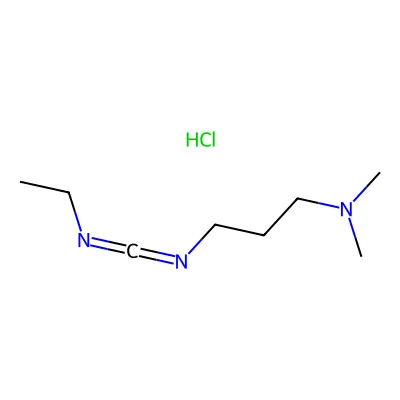
Structure of EDCI (1-ethyl-3-(3-dimethylaminopropyl)carbodiimide).
EDCI — 1,479 synonyms! Most of them are minor variations on the same theme, with slightly shuffled word order, different spacing, or different punctuation. Here is a sampling of just a few:
- EDC·HCl
- EDC-HCl
- 1-[3-(Dimethylamino)propyl]-3-ethylcarbodiimide hydrochloride
- N-(3-Dimethylaminopropyl)-N’-ethylcarbodiimide hydrochloride
- N-Ethyl-N’-(3-dimethylaminopropyl)carbodiimide hydrochloride
Chemical with the longest name
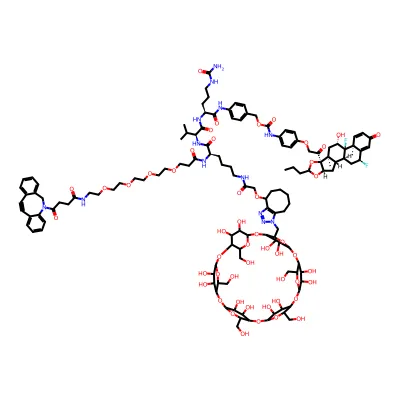
Structure of the chemical with the longest resolved name.
{4-[(2S)-2-[(2S)-2-[(2R)-2-[1-(4-{2-Azatricyclo[10.4.0.0 4,9 ]hexadeca-1(12),4(9),5,7,13,15-hexaen-10-yn-2-yl}-4-oxobutanamido)-3,6,9,12-tetraoxapentadecan-15-amido]-6-{2-[(1-{[31,32,33,34,35,36,37,38,39,40,41,42-dodecahydroxy-10,15,20,25,30-pentakis(hydroxymethyl)-2,4,7,9,12,14,17,19,22,24,27,29-dodecaoxaheptacyclo[26.2.2.2 3,6 .2 8,11 .2 13,16 .2 18,21 .2 23,26 ]dotetracontan-5-yl]methyl}-1H,4H,5H,6H,7H,8H,9H-cycloocta[d][1,2,3]triazol-4-yl)oxy]acetamido}hexanamido]-3-methylbutanamido]-5-(carbamoylamino)pentanamido]phenyl}methyl N-(4-{2-[(1S,2S,4R,8S,9S,11S,12R,13S,19S)-12,19-difluoro-11-hydroxy-9,13-dimethyl-16-oxo-6-propyl-5,7-dioxapentacyclo[10.8.0.0 2,9 .0 4,8 .0 13,18 ]icosa-14,17-dien-8-yl]-2-oxoethoxy}phenyl)carbamate
That's 736 characters long! Props to OPSIN for resolving this name to SMILES.
Nomenclature differences between the patent and academic literature
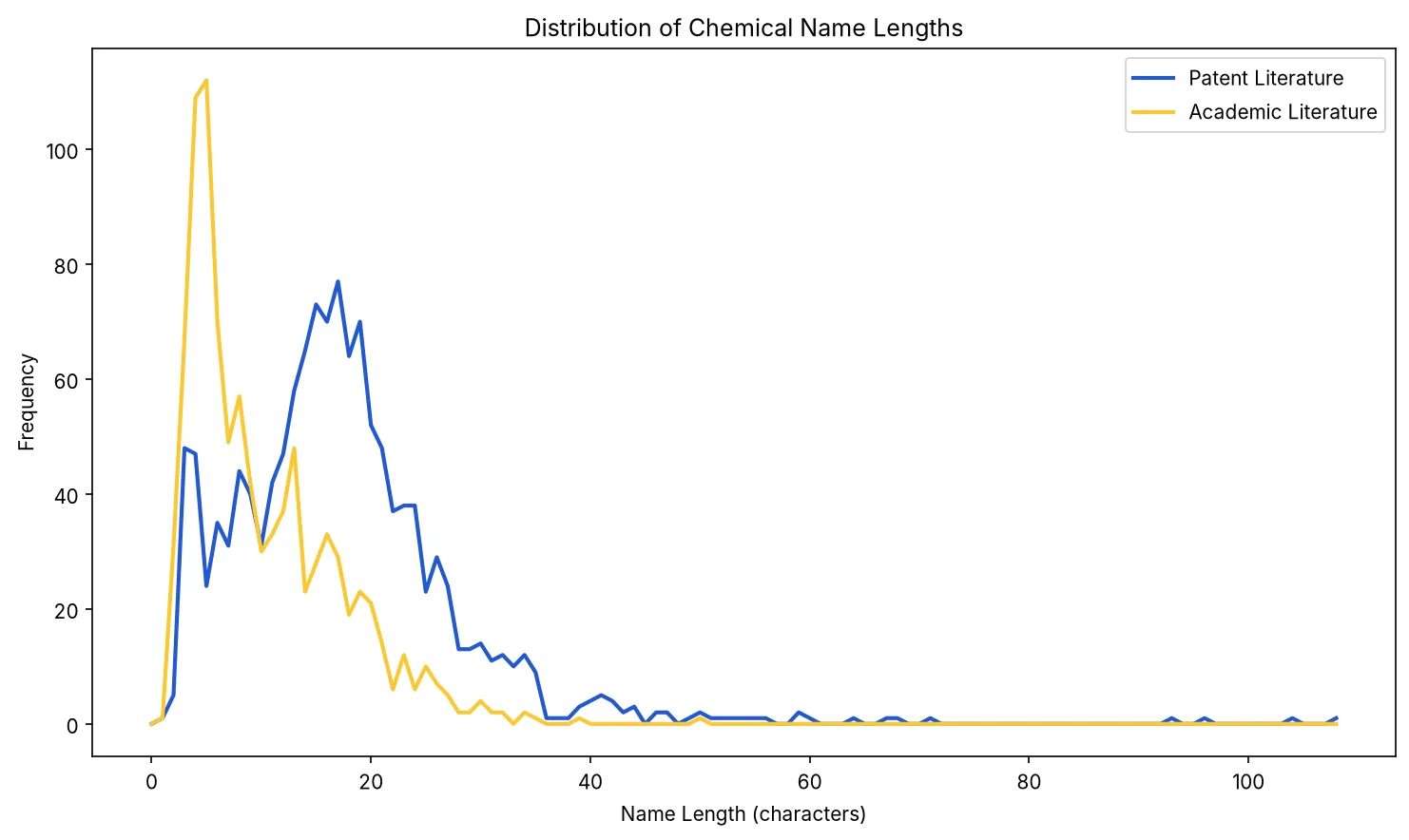
Figure 1: Distribution of chemical name lengths in the academic vs. patent literature.
One might think that the patent literature, being legal documents, would favor full systematic chemical names over the abbreviated forms more commonly seen in academic writing, and the data bears this hypothesis out. Figure 1 shows that the academic literature tends to use shorter names than the patent literature does — for chemical names that were used more than 1,000 times, the average chemical name length in the academic literature is 10.1 characters, compared to 17.4 characters for the patent literature.
Table 1 shows the 10 chemical names with the largest differences in terms of usage between the academic and patent literature. For example, take a look at sodium acetate and NaOAc — in the academic literature, "NaOAc" is the name used 71.6% of the time to describe that compound, whereas the patent literature uses the name "sodium acetate" 87.5% of the time. All of the abbreviated names in this table were more commonly used in the academic literature than the patent literature, and vice versa for the full names.
Table 1: Greatest discrepancies in chemical name usage between the patent and academic literature.
| Name | Patent % | Academic % | Diff % |
|---|---|---|---|
| tricyclohexylphosphine | 89.8% | 20.2% | 69.6% |
| Cu(OAc)₂ | 28.8% | 93.1% | 64.3% |
| sodium acetate | 87.5% | 24.6% | 62.9% |
| ethylmagnesium bromide | 96.8% | 37.5% | 59.3% |
| 4-methoxyphenol | 25.4% | 84.6% | 59.3% |
| NaOAc | 13.5% | 71.6% | 58.1% |
| CO₂ | 31.7% | 89.4% | 57.7% |
| carbon disulfide | 85.9% | 28.8% | 57.1% |
| hydrogen peroxide | 75.4% | 18.4% | 57.0% |
| FeCl₃ | 35.7% | 92.2% | 56.5% |
The average name length for compound names in the academic vs. patent literature could be the result of different choices of reagents in the two datasets, so for a more direct comparison, we looked at compounds by InChIKey that were referenced more than 1000 times in both the academic and patent literature. We found that for these compounds, the name used to describe them in the patent literature is on average 23.5% longer than the name used in the academic literature.
Are the chemical names that chemists use in synthetic procedures Zipfian?
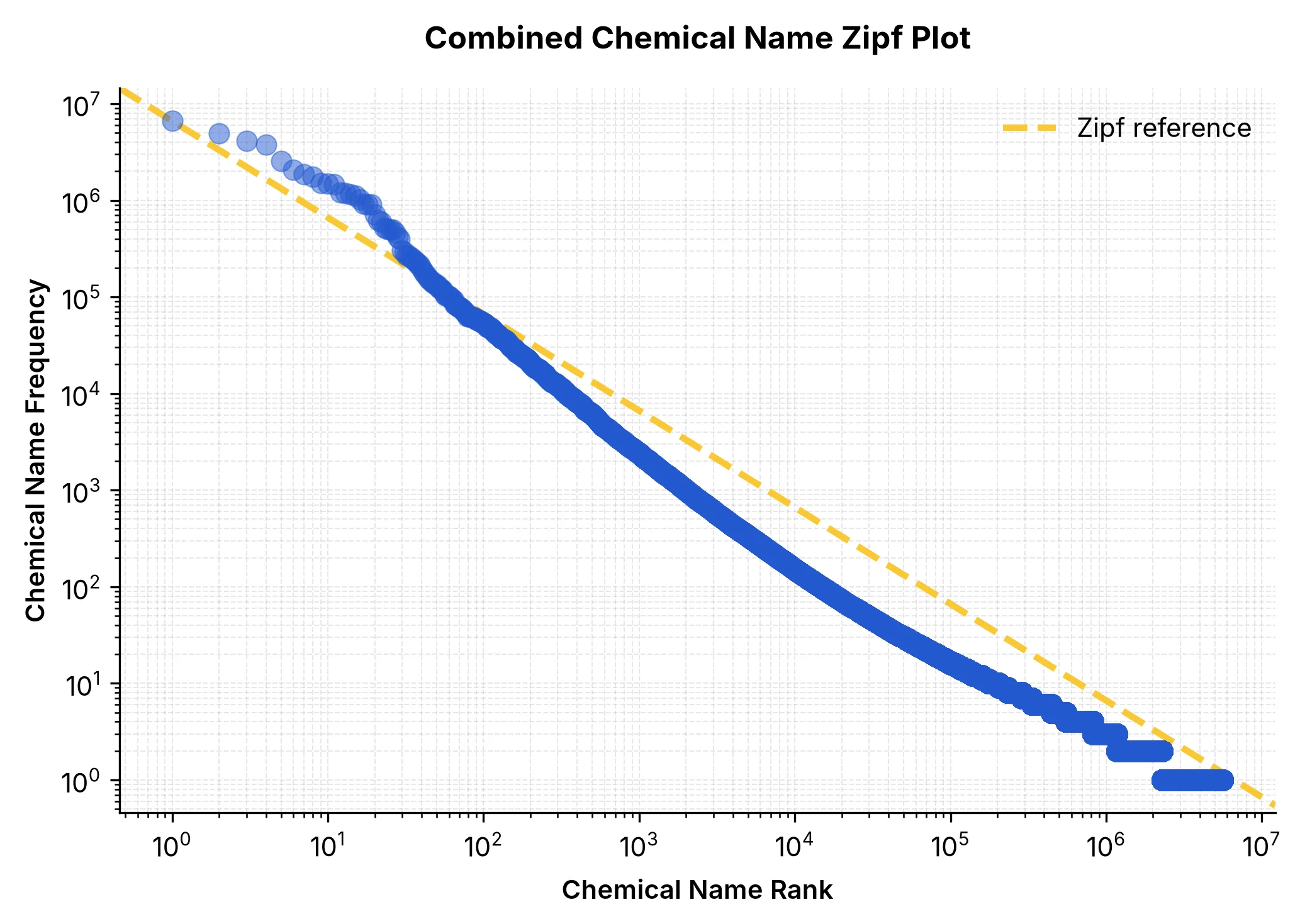
Figure 2: Log-log plot of chemical name frequency versus rank across the entire corpus.
Figure 2 shows a log-log plot of chemical name frequency versus rank across our entire corpus. In a Zipfian distribution, the most frequent item occurs roughly twice as often as the second most frequent, three times as often as the third, and so on — frequency is inversely proportional to rank. This relationship, named after linguist George Zipf, shows up in surprisingly diverse places: word usage in natural language, city populations, website traffic, and even the sizes of solar flares.
Applied to our full collection of chemical names, the pattern is approximately Zipfian. A small number of names dominate the corpus while the vast majority appear only rarely. The actual curve falls somewhat below the ideal Zipf reference line at higher ranks, meaning the tail of rare chemical names is a bit thinner than a classic Zipf law would predict.
Figures 3 and 4 show the log-log plots for the academic and patent literature separately.
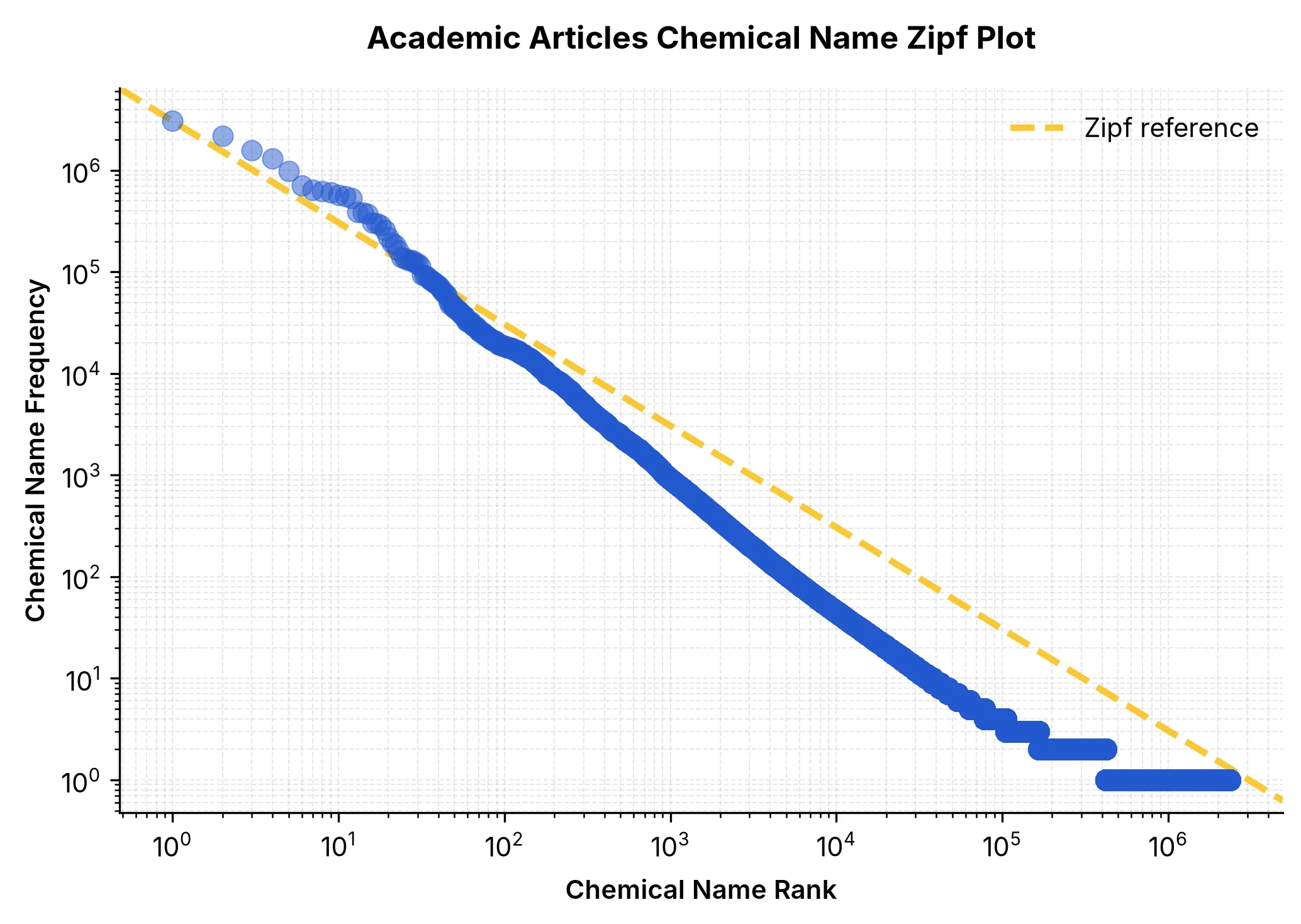
Figure 3: Log-log plot of chemical name frequency versus rank in the academic literature.
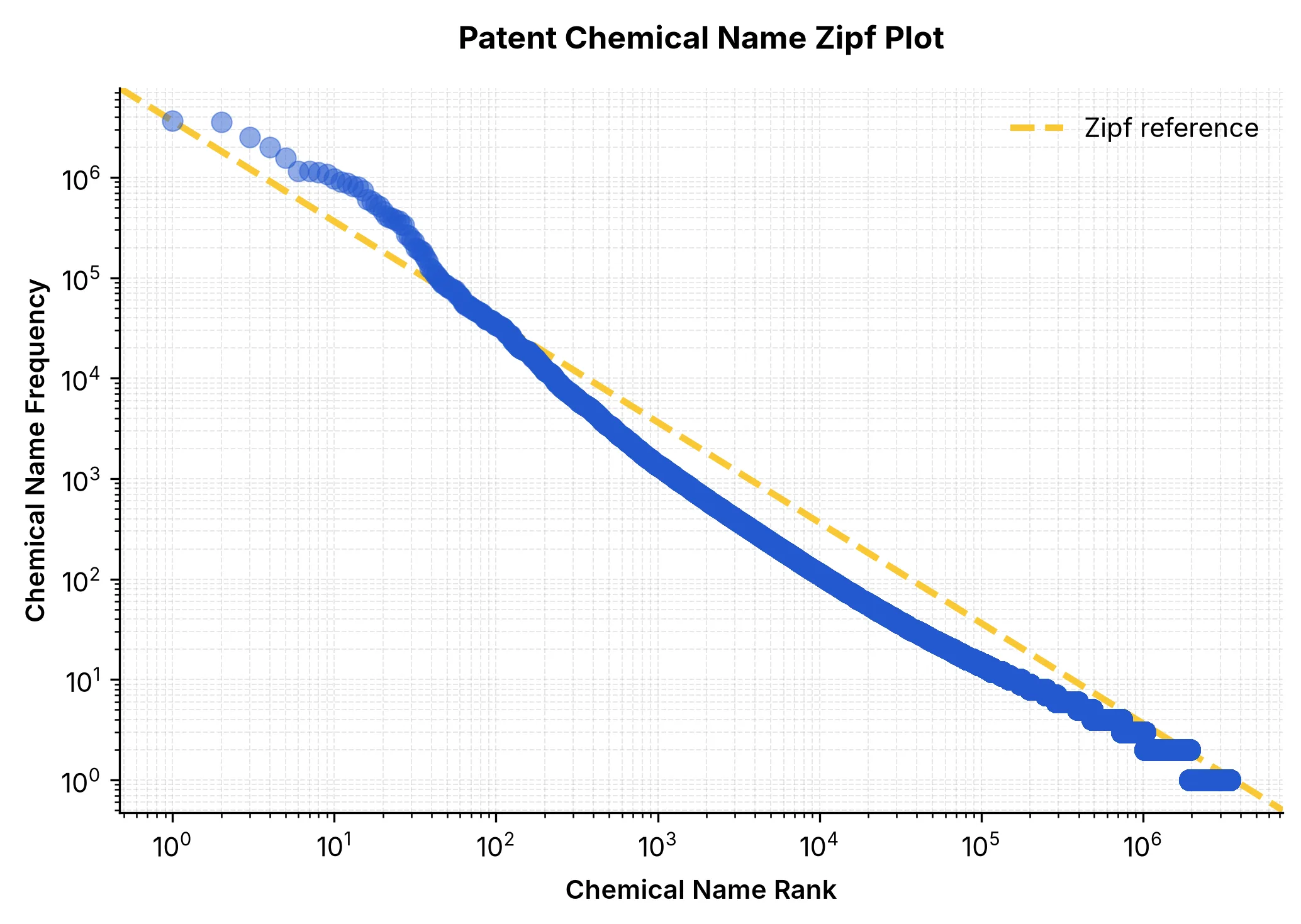
Figure 4: Log-log plot of chemical name frequency versus rank in the patent literature.
Interestingly, the academic literature curve is shifted lower than the patent literature curve at both high and low ranks, indicating that academic authors use a greater variety of names to describe commonly used chemicals, and they report a greater number of very rarely used chemical names. We plan on doing a more in-depth analysis of the differences between data extracted from the academic and patent literature in an upcoming blog post, so stay tuned for that.
Most commonly used chemicals, and their most commonly used names
Table 2 shows the 10 most frequently referenced chemicals in our corpus, along with their top 5 most commonly used names and the percentage of references for each. A few patterns stand out: common solvents and workup reagents dominate the list, abbreviations like EtOAc and MeOH are used nearly as often as their full names, and most compounds have 2-3 "primary" names that make up the majority of references. On the other hand, brine is almost universally referred to by a single name, with "brine" appearing in over 99% of references. Finally, the data also contains typos and formatting artifacts: Mg₂SO₄ is almost certainly a typo (perhaps conflation with Na₂SO₄?), and the spaced-out variants like "MgSO 4" and "Na 2 SO 4" are likely OCR or extraction errors from the source documents.
Table 2: Top 10 most frequently referenced chemicals and their most commonly used names.
| 1st most common | 2nd most common | 3rd most common | 4th most common | 5th most common |
|---|---|---|---|---|
| ethyl acetate (49.6%) | EtOAc (41.3%) | EA (4.4%) | AcOEt (2.5%) | ethylacetate (0.9%) |
| MgSO₄ (52.9%) | magnesium sulfate (31.0%) | MgSO 4 (11.7%) | magnesium sulphate (3.6%) | Mg₂SO₄ (0.4%) |
| THF (76.5%) | tetrahydrofuran (22.6%) | tetrahydrofurane (0.3%) | Tetrahydrofuran (0.3%) | thf (0.1%) |
| hexane (36.0%) | hexanes (20.6%) | petroleum ether (20.4%) | PE (8.4%) | n-hexane (6.0%) |
| DCM (30.9%) | dichloromethane (30.3%) | CH₂Cl₂ (19.4%) | methylene chloride (9.7%) | CH 2 Cl 2 (6.9%) |
| ether (32.8%) | diethyl ether (30.2%) | Et₂O (22.5%) | Et 2 O (5.0%) | ethyl ether (4.2%) |
| brine (99.5%) | Brine (0.5%) | BRINE (<0.1%) | saturated brine (<0.1%) | ice/salt (<0.1%) |
| water (80.1%) | H₂O (9.4%) | H 2 O (3.6%) | ice (2.1%) | Water (1.7%) |
| methanol (52.8%) | MeOH (43.1%) | Methanol (1.1%) | CH 3 OH (1.0%) | CH3OH (0.9%) |
| Na₂SO₄ (46.8%) | sodium sulfate (34.5%) | Na 2 SO 4 (9.8%) | sodium sulphate (4.8%) | Na 2SO 4 (3.5%) |
What's next?
One immediate application of this dataset is improving the quality of reaction diagrams generated programmatically. Tools like RDKit can render reaction SMILES as images, but by default rdkit depicts every reagent, solvent, and catalyst from the reaction SMILES with their molecular structures, producing diagrams that look nothing like what you'd find in a journal. A synthetic chemist would write "ether" or "Et₂O" below the reaction arrow: they wouldn't draw the molecular structure or write "ethoxyethane."
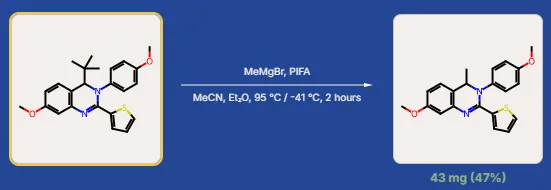
Using our chemist-preferred name dataset, we can replace SMILES strings with their most commonly used names before rendering in Saguaro Chem. The image above shows what this looks like in practice: reagents are abbreviated as a chemist would write them—MeMgBr and PIFA above the arrow, MeCN and Et₂O below it alongside the temperature program and reaction time. The result is immediately readable to a practicing chemist. In an upcoming blog post, we showcase a repo that you can use to format your chemical reaction images like this.