
Looking for a Google Patents alternative for chemistry?
Find millions of compounds, reactions, properties, and documents
Starting at just $40/month
Quick summary
- Saguaro Chem lets you search by chemical structure across patents and journals, with extracted reaction data
- If you need full-text patent search across all technologies, Google Patents is still the better choice
- Results include stepwise procedures, conditions, and yields pulled from the source documents
What is Saguaro Chem?
Saguaro Chem is a web-based chemical reaction database built for independent researchers, students, and small labs. Search synthetic procedures, reaction conditions, yields, and source documents by chemical structure, substructure, similarity, or bibliographic metadata — without an institutional subscription.
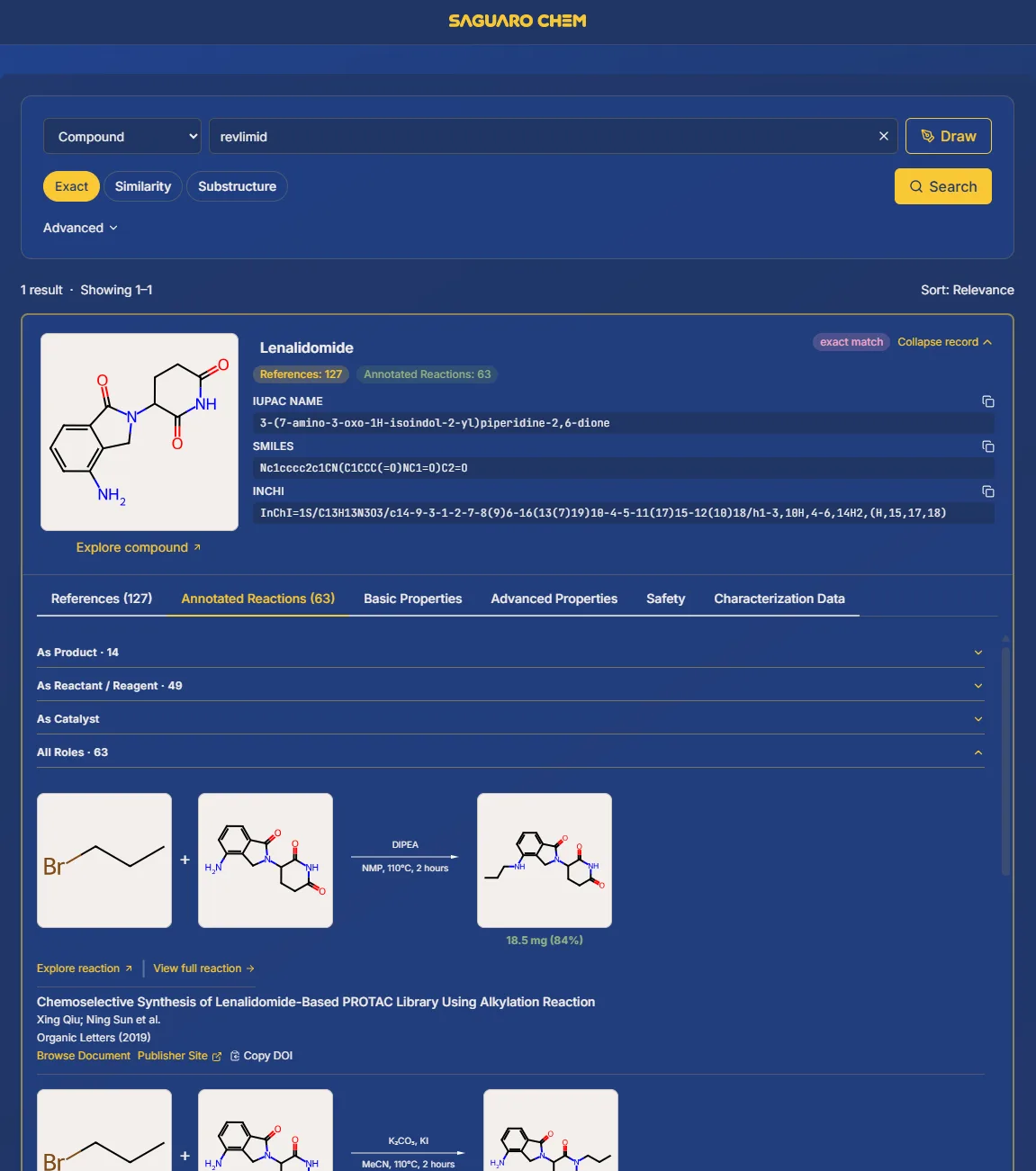
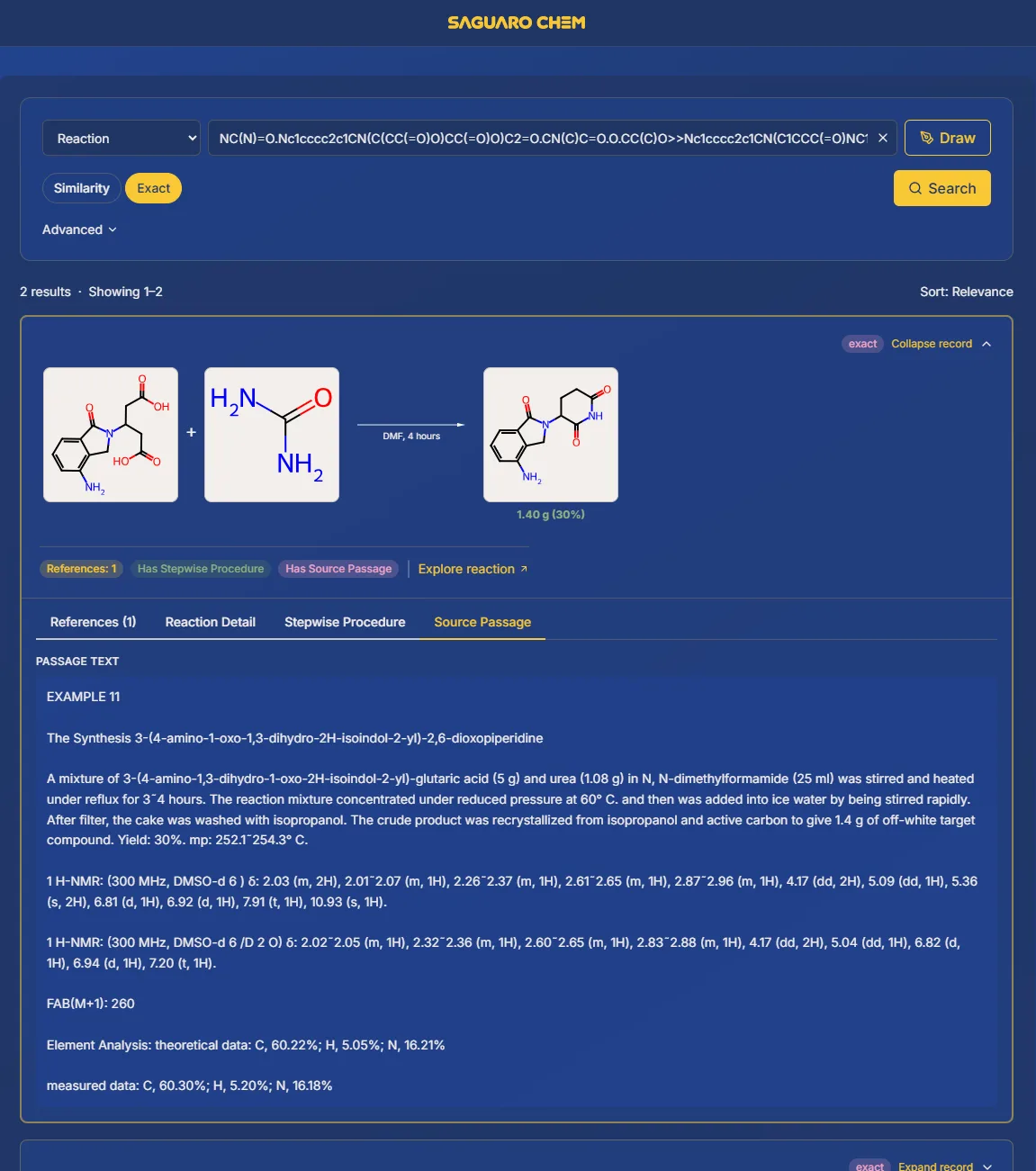
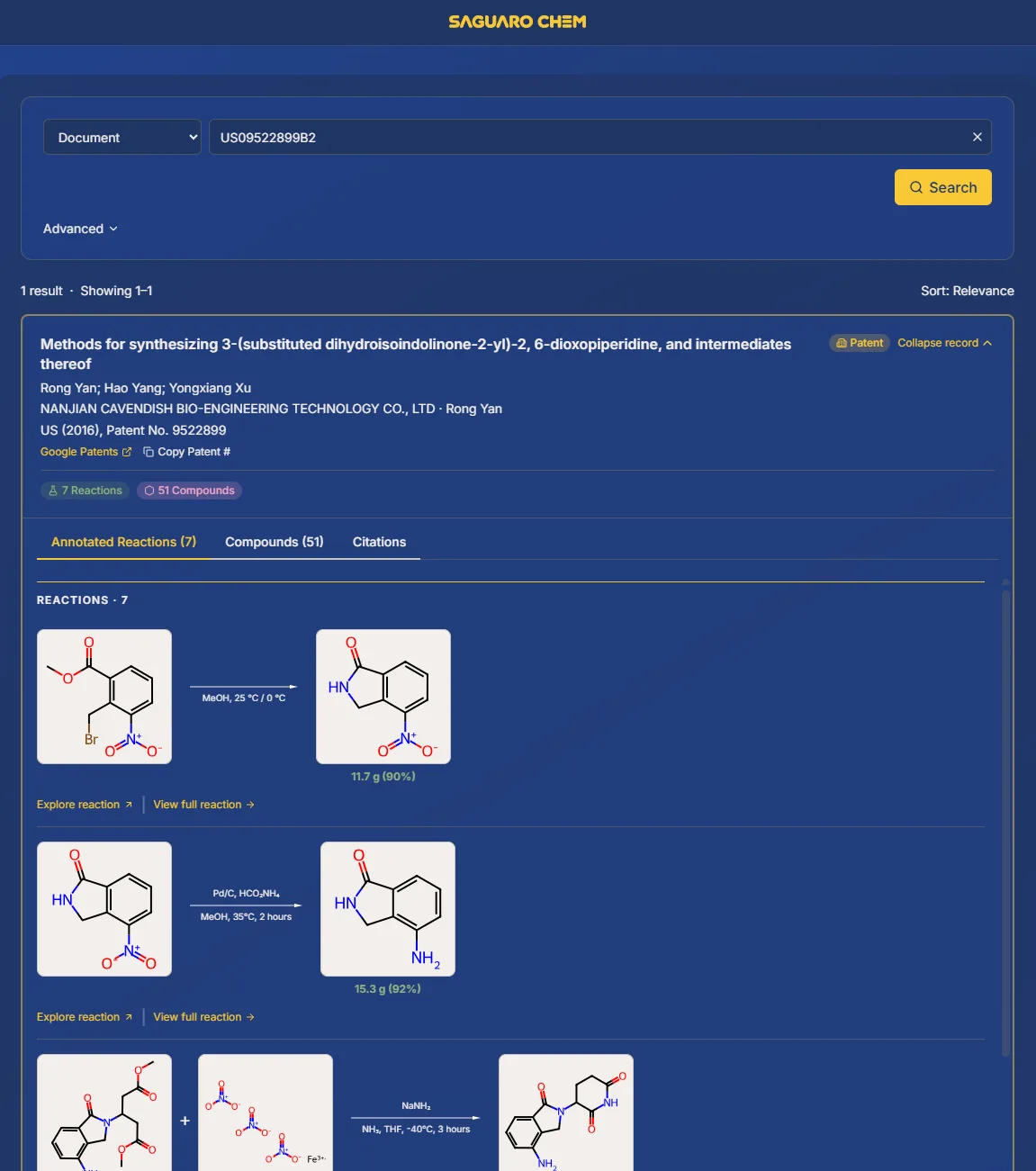
About Google Patents
Google Patents is a solid tool for finding patents. It is a free patent search engine from Google that indexes patents from major patent offices worldwide, with full-text search, patent family linking, citation tracking, and PDF download. It covers all technologies, not just chemistry. But if you are trying to find chemical reactions in patents, it gets frustrating fast. You search for a compound name and get hundreds of patent documents. Each one is dozens or hundreds of pages. Somewhere in there is the reaction you care about, but finding it means reading through dense patent text.
And that assumes you even find the right patents. The same compound can be described a dozen different ways across different patents, so a text search for one name will silently miss every patent that used a different one. Saguaro Chem approaches patent search from the chemistry side. Instead of searching patent text, you search by chemical structure. The results are reactions extracted from patents and journals, complete with procedures, conditions, yields, and the source passage. You find the chemistry without having to read the whole patent.
Is Saguaro Chem a good fit for you?
- Researchers who need structure-based patent search for chemical reactions
- Chemists who want extracted reaction data from patents without reading the full text
- Researchers who want synthetic procedures, conditions, and yields from patent sources
- Anyone who has spent hours reading patents to find a single reaction
Text search vs structure search
Google Patents searches text. You enter keywords and get patent documents that contain those words. For chemistry, this means you are searching for compound names or reaction descriptions, which can be inconsistent across patents. The same compound might be described five different ways in five different patents. Saguaro Chem searches by chemical structure. You draw a molecule or enter a SMILES string and find reactions involving that specific structure, regardless of what name the patent uses for it.
Patent documents vs extracted reactions
Google Patents returns patent documents. Useful, but you still need to find the chemistry inside. Saguaro Chem returns extracted reactions. Each result includes the stepwise synthetic procedure, reaction conditions, yield, and the specific passage from the patent where the reaction was described. You get the bibliographic details too (patent number, assignee, filing date) so you can find the full document if you need it. The difference is reading a 200-page patent versus getting the reaction data directly.
When Google Patents is still the right choice
Google Patents is free and covers all patent offices and all technologies. If you need to search patents outside of chemistry, track patent families, monitor competitor filing activity, or do freedom-to-operate analysis, Google Patents is the right tool for that. Saguaro Chem is specifically a chemistry reaction database. It does not try to replace Google Patents for general patent search. The two tools can be used together: Saguaro Chem to find the reaction, Google Patents to pull the full patent document.
What Saguaro Chem brings to the table
- Search by structure, substructure, or similarity using SMILES, InChI, or the built-in Ketcher drawing tool
- Reaction data extracted from patents and journals, not just patent text
- Stepwise synthetic procedures, reaction conditions, yields, and source passages
- Bibliographic metadata including patent numbers and journal references
- No institutional license required. Sign up individually in under two minutes
- Transparent pricing starting at $40/month with a 7-day free trial
A custom chemistry database from 30+ journals and patents
6M+
Compounds
13M+
Reaction passages indexed
15M+
Characterization details
Custom extracted data from 30+ top peer-reviewed journals and patent offices including:
- Nat. Chem.
- Organic Letters
- J. Org. Chem.
- Angew. Chem.
- Adv. Synth. Catal.
- Green Chem.
- Chem. Sci.
- USPTO Patents
Coverage is selective but spans a significant portion of each source's reaction literature.
See how Saguaro Chem works
Ready to try Saguaro Chem?
Individual
Individual access to Saguaro Chem
- Structure, substructure & similarity search
- Reaction procedures, conditions, yields & characterization data
- Source documents with DOI & patent links
- No VPN required — use from anywhere
Team
Team access to Saguaro Chem
- Everything in the Individual plan
- 3 seats included, up to 10 total
- Additional seats at $30/month each
- Centralized billing & team management
Enterprise
Custom deployment and integration for organizations
Pricing
Custom pricing for your organization
Tailored to your needs
- Everything in the Team plan, scaled to your org
- SSO / SAML & custom authentication
- Isolated or dedicated hosting options
- API access & custom data pipelines
- Dedicated support & onboarding — let's talk
No price increases without 90 days notice · Cancel any time, one click, no retention loops · Subscriptions auto-renew until cancelled.
All prices in USD. Digitally delivered subscription — access begins immediately after account activation. 7-day free trial requires a credit card; cancel before it ends and you won't be charged. All fees are non-refundable except as required by applicable law. View full subscription & billing terms
Have questions? Learn more about Saguaro Chem or contact us
Frequently asked questions
No. Google Patents is a free service from Google. Saguaro Chem offers a 7-day free trial, after which individual plans start at $40 per month. The subscription covers the cost of extracting and maintaining reaction data from patents and journals.
Saguaro Chem indexes chemical reactions from patents and peer-reviewed journals. It does not cover all patents across all technologies. Google Patents covers a much broader range of patent documents. Saguaro Chem focuses on extracting chemistry-specific data from the patents and journals it covers.
No. Google Patents supports full-text search only. It does not have chemical structure search, substructure search, or similarity search. Saguaro Chem provides all three.
Saguaro Chem provides the extracted reaction data (procedures, conditions, yields) and the source passage from the patent, along with the patent number and bibliographic details. For the full patent document, you can use Google Patents or the patent office website.
Saguaro Chem indexes data from over 13 million reaction passages — individual text segments extracted from source literature that describe a reaction. Not all data types are available for every record. Some entries include the raw source passage, others include annotated procedures, reaction schemes, or characterization data, and some may only contain the extracted compounds and their roles in the reaction. The specific data available depends on the source document and extraction quality.
Saguaro Chem indexes experimental reaction information from 30+ peer-reviewed journals, including: ACS Catalysis, ACS Chemical Neuroscience, ACS Medicinal Chemistry Letters, ACS Omega, ACS Pharmacology & Translational Science, Advanced Synthesis & Catalysis, Angewandte Chemie International Edition, Asian Journal of Organic Chemistry, Beilstein Journal of Organic Chemistry, ChemCatChem, ChemMedChem, Chemical Communications, Chemical Science, Chemistry – A European Journal, Chemistry – An Asian Journal, Chinese Journal of Chemistry, European Journal of Organic Chemistry, Green Chemistry, Journal of Medicinal Chemistry, Molbank, Molecules, Nature Chemistry, Nature Synthesis, New Journal of Chemistry, Organic & Biomolecular Chemistry, Organic Chemistry Frontiers, Organic Letters, Synlett, Synthesis, Tetrahedron, Tetrahedron Letters, The Journal of Organic Chemistry.
Yes. Saguaro Chem currently indexes reaction information from USPTO granted patents. We are actively working to expand patent coverage to additional patent offices in future updates.
Yes. Saguaro Chem extracts and indexes stepwise experimental procedures directly from source literature. Each procedure includes reagents, quantities, reaction conditions, and workup steps where reported, presented in a clean, structured format so you can reproduce the synthesis in the lab.
No. For reactions sourced from academic articles, Saguaro Chem does not display the source text or distribute PDFs. Instead, we try to show as much non-passage context as possible in the form of a reaction scheme and an annotated procedure, along with characterization details where available — though the specific data types available may vary by entry and are not necessarily comprehensive. Each entry links back to its original source so you can access the complete publication or supplementary information on the publisher's website.
Yes. Unlike academic articles, Saguaro Chem does display the raw source passages from patents for reactions sourced from patent literature. Each patent-sourced entry includes the relevant excerpt from the original patent text alongside the structured data, so you can read the procedure, conditions, and characterization details exactly as they appear in the patent.
Yes. We never log the contents of your search queries — no SMILES strings, no structure drawings, no text searches are ever recorded. Our infrastructure is hosted on SOC 2 Type II compliant hosting (Railway), accounts support two-factor authentication via Clerk, and IP addresses are truncated and hashed before any storage.
All payments are handled by our authentication provider, Clerk, which uses Stripe as its underlying payment processor. De Novo Chem never sees, stores, or handles your credit card information — the entire payment flow is managed by Clerk and Stripe.